


Jesse is done waiting. He gives Wade until Friday to introduce him as a partner instead of a roommate and gets back a man who finally stops promising and starts doing. But when Wade pushes Jesse to let himself be taken care of, the offer cracks open a door Jesse has kept sealed since he was seventeen, and the truth about a man named James rewrites everything Wade thought he knew about the walls Jesse lives behind.

You can download the EPUB version of this story to date HERE if you prefer to read on your Kindle or other device.

CONTENT WARNING: This Chapter discuss an off-page, prior sexual assault. No details or specifics of the assault are given, however, as this is a sensitive trigger for many individuals, reader discretion is advised. Please contact me if you would like more specifics on what is actually discussed on-page before reading.

Jesse’s Point of View
By Tuesday the cuts on my shins had stopped pulling when I walked. Still pink and still tender, I wouldn’t be swimming for another week, but the skin was closing over and the bandages were off, and when I woke up that morning I knew it was time.
It didn’t arrive in a single thought. It had been settling since Monday, when I stood at the kitchen island with my coffee and watched Wade move through the room the way he always did, spacious and loud and sure of his place in it. Something in me had stopped watching.
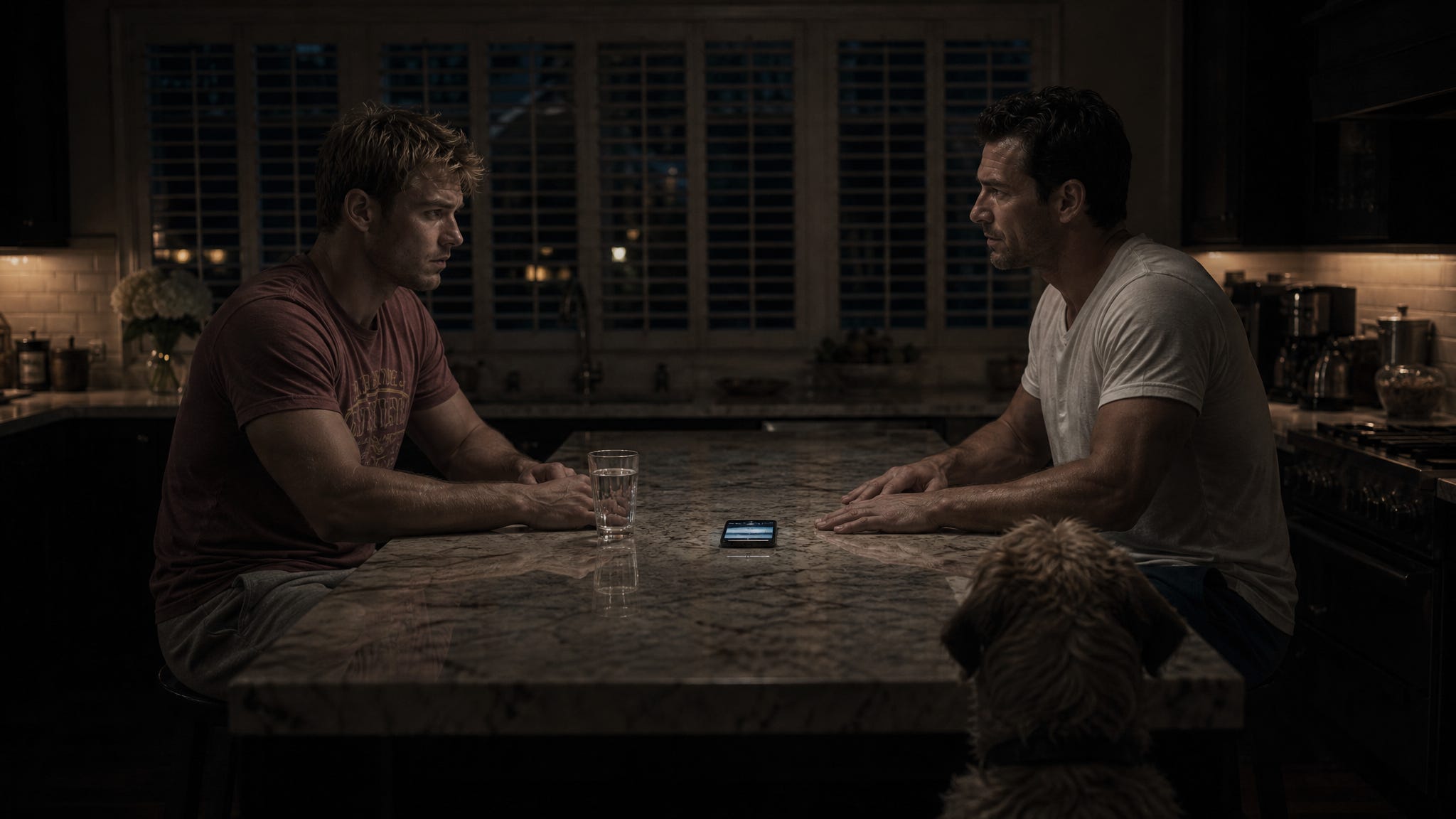
I set the island for two. Not for dinner, just two glasses of water on opposite sides, a placemat for each, the kitchen chairs pulled out so neither of us could pretend to be passing through. Mercer watched from the corner. His tail swept once across the tile, uncertain whether this arrangement meant food or trouble.
The island, not the couch. God, not the couch. The couch was where we sank into each other, where the world went soft and quiet and forgetful, and I wasn’t here for soft. I wasn’t here for forgetful. The island had a counter between two people and nowhere to put your feet up, no cushions to collapse into, no easy way to close the distance. It asked you to stay upright. It asked you to stay present. I wanted that. I wanted the hard surface and the cold granite and the space between us that would keep me honest.
In the living room, Jake was stretched out on the couch with a book open on his chest, half asleep the way he’d been most evenings since the ambulance. He’d moved his bag into the guest room without being asked, and nobody had said when he’d go home. It was just the way the house was now. He had seen me at my absolute worst, my lowest, and he was still here, without judgement, without demand. I didn’t know what to do with that.
Wade found me there at seven. He’d just come from the shower, his hair still wet and the collar of his t-shirt darkened where the water had run down his neck. He looked at the island, at me, at the glasses, and his face performed the calculation it does when he’s sizing a conversation before committing to it.
“Sit,” I said.
He sat.
The granite was cool under my forearms. I hadn’t turned the overhead lights on. The under-cabinet lighting was enough for tonight. Outside the pool filter churned its evening cycle. The sound had become something by which I measured time.
“You said Friday,” I said. “When you gave me the timeline for the closet. You said Friday.”
“I did.”
“I’m holding you to Friday. Not soon. Not I’m working on it. A room, a person, a name. You introduce me as something other than your roommate, or you tell me to my face that you can’t. Either answer. But I need it before Friday, and I need it to be a real one.”
He didn’t say I know. His hands rested flat on the granite and he nodded once, and I could see the effort it cost him not to fill the silence with something easier.
“Done,” he said. “Friday. Dinner with Greg Pearson at Del Frisco’s. Greg and his wife. No crowd, no room full of people to perform for. I’m going to introduce you as my partner.”
The word done came out too assembled. Three weeks of rehearsals had gone into it. I could hear them in there, the shower, the truck, the silences he thought I couldn’t hear. I’d heard that same voice every time he’d said soon. This time the thing behind it was heavier, but I’d been fooled by heavier before.
“You practiced that.”
He didn’t blink. “Yeah.”
“How many times?”
His mouth twitched without becoming a smile. “Enough to hate hearing my voice.”
I hadn’t expected the name. I’d expected a plan, maybe the shape of one, something vague and forward looking that could be adjusted when the moment came. Not a man’s name and a restaurant and a night, all specific and real and walking toward us on a calendar. The specificity landed somewhere behind my ribs and sat there, warm and heavy, like a roast pulled from the oven.
“The other thing,” I said. “Sex.”
His shoulders shifted, and something behind his collarbone drew tight, not quite a flinch.
“You told me you talked to Jake,” I said. “I don’t need the details of what he said. I’ve got a pretty good idea, and I don’t need it spelled out. What I need to know is what you’re going to do differently. Not promise differently—I’ve got a collection of those, thanks. Do. What are you going to do?”
“I called the specialist Monday.” He said it flat with no performance, no sales pitch, just the fact laid down between us like a card on a table. “Pelvic floor specialist. Appointment’s Thursday. They had a cancellation.”
He reached for his phone and set it on the island between us. A calendar notification glowed on the screen: Thursday, 2 PM. Dr. Sarah Nguyen. Pelvic floor rehabilitation.
“And the conversation about what’s been happening with your body, the real one, not the one where I tell you it’s fine and you tell me you’re fine and we both pretend the floor isn’t falling out. I’m ready to have it whenever you are. I’ll bring what Jake told me and I’ll listen to the rest.”
He didn’t say I know. I’d been listening for it the way you listen for a floorboard you know is going to creak. That reflexive tensing before the sound, the body preparing for what the ear is about to confirm. It didn’t come. Three answers, three specific and honest things, and not once did he say I know, not once did he reach for the easy bridge of false understanding. Just the facts, offered without decoration.
He reached back to the phone. Opened up the Amazon app.
“I already bought a set. Graduated. Small, medium, large. Medical-grade silicone. They came yesterday.”
I looked at the notification. At the man across from me who’d spent three weeks saying soon and who had already made the appointment before I’d held him to it, already ordered the equipment, already done the logistics.
“And I’m not giving you a countdown anymore,” he said. “Jake said that makes it worse. Saying it beforehand. Your body starts—”
“Bracing.”
“Yeah.” His jaw flexed. “That.”
Something shifted in my chest. Not trust. Not yet. Recognition. This was action, not performance. He had heard what I’d said or what Jake had said and he had moved on it without first asking for credit.
“The last thing,” I said.
He waited.
“I’m not going to survive another party,” I said. “I’m not going to survive another drawer, another night where you make a decision that puts me somewhere I can’t breathe and then act surprised when I come back different. I need to know that the person I’m sleeping next to is going to make decisions that include me before the damage is done. Not after. Not when I’m already bleeding. Before.”
“I know.” He stopped. “Sorry. I’m . . . I’m working on that.”
“I know you are.” I looked at him across the island. “That’s the first time I’ve believed it.”
Jake shifted on the couch. Neither of us looked at him. This was between the two of us, and Jake knew it, and his presence was the only reason I’d been able to say any of it without the floor opening up underneath me.
“I’m not asking you to be perfect,” I said. “I’m asking you to be in the room. When it matters. When I’m in the room. When there’s a decision that affects both of us. I’m asking you to stop leaving.”
“I’m not going to leave again.”
“You said that last time.”
“I know. And I left anyway. And I’m not going to tell you that makes it okay, because it doesn’t. I’m just telling you I know what I did, and I know what it cost, and I’m not going to do it again.”
I nodded. Not forgiveness, not even trust, just acknowledgment. The fact of him saying it, the fact of me hearing it, the fact of the island between us and the evening light coming through the shutters and the dog on the couch and the man on the other side of the counter who had finally, finally stopped saying I know long enough to say something that mattered.
“Jaegen. That’s done. I called him the morning after. In front of Jake.”
“Jake told me.”
“And the closet. Friday. Before you have to ask again.”
“The specialist.”
“Thursday. And the . . .” He gestured toward the counter. “Already in the nightstand.”
I looked for the performance. I looked for the man who filled silence and deflected and offered logistics as a substitute for change. He was still there, somewhere under the surface of the man at my kitchen island. But something in the arrangement was different. He’d done the work before I’d asked for it. He’d answered the question before I’d made it one.
I picked up his phone and looked at the calendar notification again. The name, the time, the address a real place, on a real day, and not a single word about soon.
“I’m not ready to trust this yet,” I said.
“I know.”
“But I noticed.”
He nodded. I put the phone back on the island between us and we sat there for a while, with the under cabinet lights and the pool filter and Mercer’s tags settling on the tile, and neither of us said anything.

Wade’s Point of View
Greg Pearson had a handshake that lasted two seconds too long. He’d always done it. Eight years of business dinners and the man still held on like he was trying to prove something. I’d stopped noticing it years ago. Tonight I noticed everything.
The steakhouse was the same one from the business dinner earlier this month, the one where I’d introduced Jesse as renting the other room. Private room in the back, the kind with leather booths and wine lists printed on actual card stock and servers who knew your name. Greg was already seated when we arrived, his wife beside him, a glass of Cabernet already half gone.
Jesse walked in ahead of me. He’d put on the navy button-down I’d bought him in September, the one that fit across his shoulders without pulling, and he’d done something to his hair that made it look intentional instead of like he’d just come from the pool. He looked like he belonged in this room, which he did, and I’d spent four months pretending otherwise.
“Wade,” Greg stood. The handshake. The two extra seconds. “And this must be—”
“Jesse,” I said. “My partner. My boyfriend. We’ve been together almost a year.”
The word boyfriend left my mouth and landed on the table between us like something I’d been carrying in my pocket for months and finally set down. Greg’s face did the thing they do when they’re recalibrating, a half-second of surprise that he covered with the practiced warmth of a salesman, worn like a second suit.
“Well,” he said. “It’s good to finally meet you properly.”
Jesse shook his hand. “Likewise.”
We sat and the server came. Jesse ordered the salmon because he always ordered the second-cheapest thing on the menu and the salmon was close enough that he didn’t have to feel bad about it. I ordered for both of us once, early on, and the look he’d given me had been so quiet and so final that I’d never done it again.
Greg’s wife, Carol—I’d met her twice, both times at dinners where I’d done most of the talking—asked Jesse what he did. He told her. Art history and business, full time at UNT. She asked about the restaurant. He answered without apologizing for it, without making it sound temporary or lesser, and I watched her decide the thing was worth hearing when she set her fork down and leaned in. That was the tell. Nobody leaned in for me at these dinners. They leaned back and let me talk.
“You know,” Greg said, swirling his glass, “a few weeks back, you told me he was renting a room. I remember thinking, well. Sure he was.”
The table went quiet. Not the bad kind of quiet. The kind where a truth lands and everyone needs a second to decide where to look.
“I was renting a room,” Jesse said. He didn’t look at me. He looked at Greg without flinching, which was worse. A man who’d been introduced as a roommate one time too many and who had decided, quietly, to stop being that person. “I’m not anymore.”
Greg held his gaze. Then he raised his glass. “To not renting a room anymore,” he said, and Carol laughed. A real laugh, not the dinner one, and Jesse picked up his water and drank and something in my chest unclenched that I hadn’t known was clenched.
The rest of the dinner ran on that current. I watched Jesse across the table, the candlelight on his jaw, the serious line of his mouth, the way he held his fork with his whole hand when he thought no one was paying attention, and I kept catching myself doing it and kept not caring that I was. At one point Greg asked about the house, about the renovations I’d been planning, and I talked about them for a while, and then he turned to Jesse and said, “And what do you think? Is Wade going to actually finish the guest bathroom or just keep talking about it?”
“I think he’ll finish it,” Jesse said. “Eventually.”
Greg barked out a laugh.
Jesse took a sip of water. “He finishes things when they start embarrassing him.”
It wasn’t a compliment. It wasn’t a criticism. It was the most precise thing anyone had said about me in a room where I’d spent years managing how I was perceived, and Jesse had delivered it without looking at me, without asking for acknowledgment, as though it were simply true and therefore didn’t require performance.

Greg laughed. Carol smiled. The dinner traveled on.
In the car afterward, the silence was different from the one after the business dinner. That one had been heavy with the things Jesse wasn’t saying. This one was lighter, settled rather than empty. The silence of two people who had been somewhere and gotten through it.
Jesse sat in the passenger seat with his window cracked. The October air was cold and it moved through the car with the scent of late autumn. Wet leaves, diesel from the highway, the distant smokiness of someone’s fireplace.
He didn’t say thank you. He didn’t say that meant something. He put his hand on the console between us, palm down, and left it there, and I covered it with mine, and the rest of the drive home was just the road and the dark and the weight of his hand under mine.

Jesse’s Point of View
A week later we were eating at the island, takeout from the Thai place on Preston, containers spread between us, the television on in the living room for the dog’s sake but neither of us watching it. Jake had gone home after Wade made good on his promise to introduce me as his boyfriend. He’d been here for us, for me, longer than I had a right to expect. The house felt emptier now, but I couldn’t ask him to stay. I never had the right to ask in the first place.
The weekend smell of rain still hung in the house. October had settled into its last weeks and the nights had gone cold enough that Wade had started closing the back door, which meant the pool filter was the only outside sound, its late-cycle hum the thing I learned to count by.
Wade had been careful since the closet date. Not tentative, but careful. There’s a difference. He used fewer words. He hadn’t said I know in longer than I could track. When he reached for me at night, not for sex, just his hand on the small of my back or his palm against my shoulder blade, there was a question inside the touch that hadn’t been there before. I’d been letting it stay.
He put his chopsticks down.
“I want to talk about something.”
“You’re already talking.”
The corner of his mouth moved. He let me have it, then squared himself the way he did before a conversation he’d been rehearsing in the shower. His shoulders shifted back and his hands came to rest, a man braced for something he couldn’t quite make comfortable.
“The insurance thing,” he said. “What you said when you woke up. ‘Of course I don’t have insurance. I’m poor.’ That’s been—” He stopped. Rearranged. “I haven’t been able to let it go.”
“Let what go? That I’m poor? That observation isn’t new, Wade.”
“That you’re running yourself into the ground. Forty hours a week on top of classes and swimming and now therapy and counseling and pelvic specialists, and you’re trying to heal from . . .” He gestured toward my shins, toward the cuts that were nearly gone, toward the whole situation that had produced them. “Something has to give. Let it be the one thing that can wait.”
I set my chopsticks down slowly.
“I want you to quit your job,” he said.
My face abruptly did something without checking with the rest of me. I felt it happen. A stillness, the kind that begins behind the eyes and spreads outward, flattening everything it touches. The takeout container between us. The rice I hadn’t finished. The granite under my elbow. All of it going distant and precise and cold.
“Not forever,” he said quickly, the words coming faster now. “Not a permanent thing. Just while you finish school. Let me cover the expenses while you—”
“No.”
“Jesse—”
“I said no.”
“You didn’t hear me out.”
“I heard you. You want me to stop earning money and live on yours. I heard you.”
“It’s not . . . I have money sitting in accounts I haven’t touched in years. You could finish school, focus on the swimming, the therapy—”
“I don’t care how much you have.”
“It’s not about the amount. You’re driving yourself into the wall. Classes until noon, then work until ten or midnight, then swimming, then therapy twice a week and counseling once. You’re doing all of it on the same amount of sleep and the same amount of money, and you almost . . .”
He didn’t finish. We both knew what he was going to say. You almost died on my floor. The memory of it, the glass, the bourbon, my cut and battered body, lived between us like something we’d both agreed not to disturb.
“I need the job,” I said.
“Why?”
“Because it pays for shit that isn’t you.”
His jaw clenched. I watched him make the effort, his hands pressing flat on the granite, the breath taken through the nose, choosing patience the way you choose a chair. Deliberately, knowing you might not get to stay in it.
“I’m not asking for control,” he said. “I’m not asking you to be—”
“Dependent. You can say it.”
“—dependent on me. I’m asking you to let me help. Just until you’re through school. That’s all I want . . . to take care of you.”
The words hit something behind my chest. A hard surface, one I knew was there but hadn’t expected to feel so quickly. A door closing. A window sealing shut. The sensation was specific. Pressure, then a click, then airlessness.
“You don’t understand,” I said. My voice had changed. I could hear it from outside, the way you hear yourself on a recording. Lower, flatter, and stripped of anything that might be mistaken for negotiation. “You can’t understand.”
“Then help me.”
“The last time someone offered to take care of me, I ended up . . .”
The sentence died. I heard it die the way you hear a phone call drop. The sudden absence, the shape of where the words were going hanging in the air like a cut wire.
Wade’s hand moved across the island toward mine. Slowly, the way you’d move toward something that might bolt.
“Ended up hurt?” His voice was barely above a whisper. “You ended up hurt?”
I pulled my hand back. Away, out of reach, automatic and complete.
“It doesn’t matter.”
“It matters if you were about to say it.”
“No, it doesn’t. Drop it.”
“Jesse—”
“Drop it.”
The door I’d cracked open was closed again. I pushed back from the island, carried my container to the fridge, and stood with my back to him and my forehead nearly touching the cool surface of the door. Behind me, Wade sat at the island with his hands where I’d left him and didn’t follow.
“There’s more ice cream,” he said.
The pivot was so quintessentially Wade that the sound that came out of me wasn’t quite a laugh.
“Sure,” I said.
And we ate ice cream at the kitchen island, sitting across from each other in the half dark, while the half-formed sentence floated between us. The last time someone offered to take care of me I ended up . . . Neither of us reached for it.

The next evening I cooked. Nothing fancy, just chicken, vegetables, rice. Something that filled the house with warmth and didn’t require me to make decisions beyond the order of the cutting board. We ate at the island because the island had become our place, the site of every conversation that mattered, a surface we’d both put our weight against at moments when the rest of the room wasn’t sturdy enough.
When the dishes were in the sink, Wade dried his hands on the towel and held it without hanging it, his body carrying the tension of an evening’s worth of held-back questions finally released.
“Have you thought about what I said?” he asked. “About the job.”
I had been thinking about it. Not since last night. Since the ambulance, the insurance question, the paramedic asking Do you know if his insurance prefers one or the other and Wade answering I don’t think he has insurance. Since the word poor had come out of my mouth and landed in a house where a man who financed buildings worth more than everything I’d ever owned was standing over me deciding whether I could afford to go to a hospital.
And longer. Since I was seventeen years old, sleeping in a Honda Civic in a Walmart parking lot, trying to figure out what a seventeen-year-old with no money, no family, and no address does in the morning.
“I thought about it.”
“And?”
“No.”
He set the towel down. “You keep hearing a version of this that I’m not saying.”
“You keep saying it like the wording’s the problem.”
His face moved with confusion first, then something slower, a wall he hadn’t known existed coming into view.
“I’m not offering to control anything.”
“No. That part comes later.”
“That’s not fair.”
I laughed once, devoid of humor. “No. It usually isn’t.”
He took a step closer to the island, then stopped himself there. “Tell me what you’re hearing.”
“Don’t.”
“What.”
“Don’t use that voice with me like you’re handling a bomb.”
“I’m trying not to make it worse.”
“You already did.”
His hands rested on the granite. He leaned forward slightly, then stopped himself. His hands stayed flat.
“What do you hear?” he asked.
The door was open again. I could feel it, the same crack from last night, the same pressure from behind it. I could close it. I could say forget it a second time, change the subject, go to the bedroom, let the fragment float in the air between us the way it had yesterday. I’d done it before. It was the thing I was best at. Walking away from a conversation before the conversation got to the part that costs.
But the door kept reopening, and the thing behind it was pressing forward the way a swimmer’s lungs press toward the surface. You can hold, but the water keeps bringing you up and I understood, somewhere below the place where discipline lived, that the door wasn’t going to close this time.
“The last time someone wanted to take care of me,” I heard myself say, “I ended up—”
I stopped. Rather my body had stopped before my mouth did. Hands, shoulders, the breath drawn in and held. Everything locking down the way it did at the party, the way it did in the bedroom, the way it did when something was coming that I couldn’t get past sideways.
“Ended up hurt?” Wade whispered. “Did somebody hurt you?”
“No.”
A door coming down. A flat surface. The word hanging in the kitchen and settling into the tile the way cold settles into a house when the back door’s been left open all day.
I looked at the granite between us. At the distance between his hands and mine. At the surface we’d been leaning on for weeks and everything underneath it. Everything I’d been building over for years, the way you build over a sinkhole. Carefully, with good materials, until one good rain.
“The last time someone offered to take care of me, he demanded sex as rent.”
The sentence landed on the granite between us like a dropped glass.
“His name was James,” I said. “And when I said no, he—” My mouth went dry. “He didn’t stop. He took.”
I looked away and closed my eyes until the visceral part of the memory passed.
Wade’s face was white. From understanding. The beginning of it.
“I was seventeen. I’d just been kicked out of my house.” The next words I hadn’t said in years, not out loud, not to anyone. “My parents found out I was gay. Someone at school found something. A text, I think, I don’t even remember what. Something stupid, something private, something that wasn’t meant for anyone but the person I sent it to. By the end of the day, the whole school knew.”
I could still feel it. The hallway, the looks, the way the world had rearranged itself around me in the space of a morning. The same faces, the same lockers, the same fluorescent lights, but everything different. Everything watching.
“My parents didn’t take it well.” Rick. My mother. The kitchen table, the silence, the way Rick’s face had gone from confusion to disgust to something worse than either. A cold, practiced rejection, the kind that had been waiting for an excuse. “They told me to get out.”
Get out. Two words. That was all it took. Two words from the man who’d taught me to ride a bike and throw a football and tie a tie, and I was standing on the porch with a backpack and the clothes I was wearing and the door was closed behind me and I was seventeen and I was alone.
“I left with a backpack and the clothes on my back, and I didn’t have anywhere to go.”
“They came back to me later.” The words were careful, chosen from a place I’d been keeping tidy for years. “My mother first. She always found me eventually, even when I didn’t want to be found. Rick took longer. We don’t talk about it. The porch, the backpack, any of it. But they came back. They’re in my life now, in their way. It just took me a long time to stop flinching when they called.”
The kitchen was very quiet. The refrigerator hummed. Outside a dog barked twice and stopped. I knew the sound, the neighbor’s yellow lab, the one who barked at things that weren’t there and looked proud of himself.
The words kept coming. I couldn’t stop them. They were like something dammed up for years, and the dam had broken, and the water was moving, and I was just standing in it, letting it carry me.
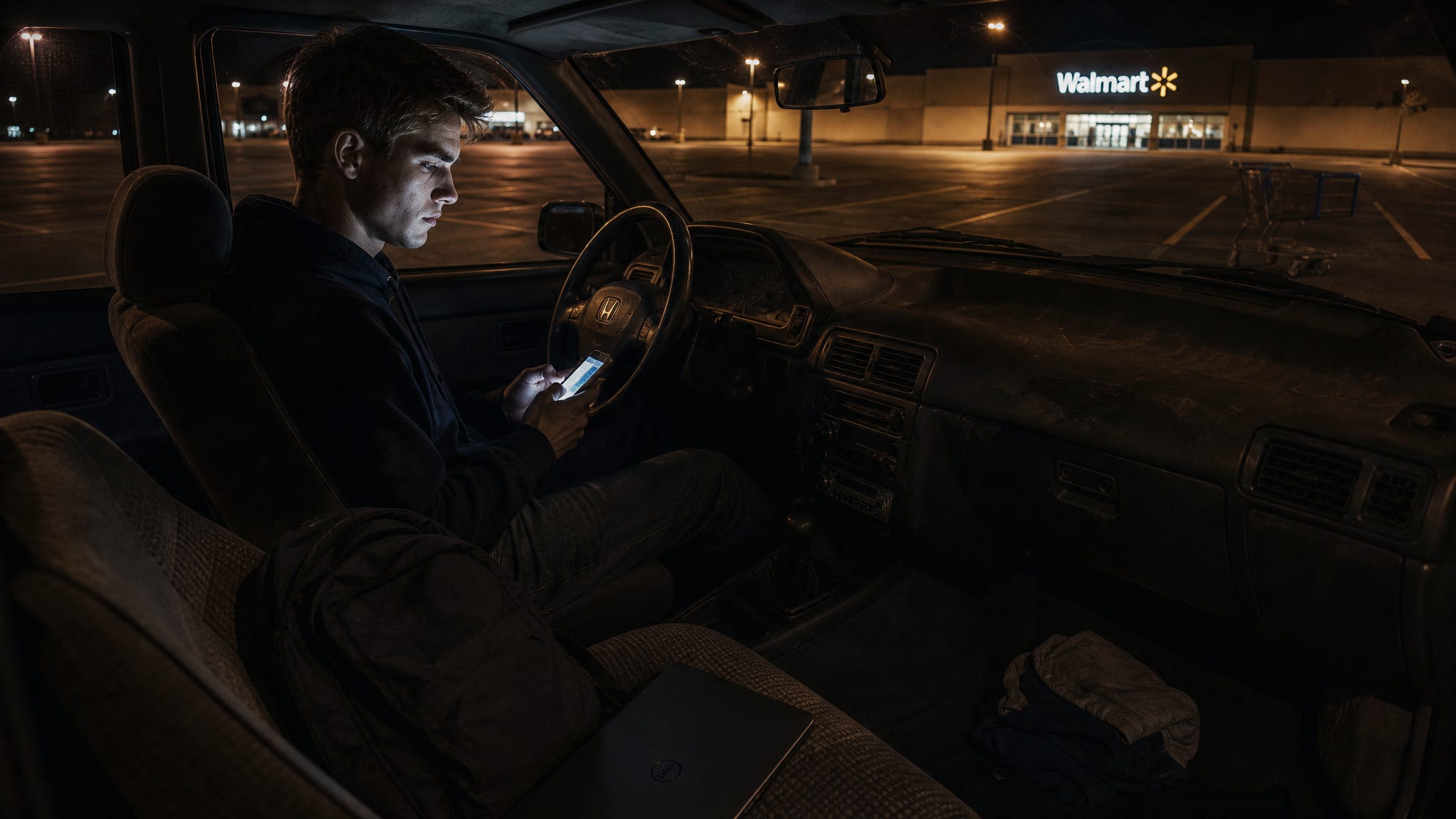
“I slept in my car for three days. A Walmart parking lot. I had some clothes, my school laptop, and twenty dollars. I didn’t know what to do. I was seventeen. I’d never been anywhere by myself in my life.”
Wade didn’t speak. I felt his silence the way you feel a hand hovering over a wound, not touching, but close enough that the heat reaches you.
“James was from a gaming group I was in. Online at first, then in person. He was twenty. He had an apartment.” I paused. The next part had a weight to it, and I needed a second to steady myself before I put it down in the room. “When he found out what happened, someone in the group told him, he called me and said I could stay on his couch.”
“It was kind at first.” My voice was steady. The voice I used for billing questions and registrar’s offices and every other conversation that required me to be an object that moved through a system. “He didn’t ask for rent. He bought groceries. He drove me to school. He was . . .” The word came out. “He was kind.”
The silence shifted, now full of something that pressed against the walls.
“What I didn’t get—what I didn’t see—was that he thought I owed him for it. At first it was little shit. Sit closer. Spend more time with him. Tell him where I was going. Who I was with. Then it got bigger.”
My hands were flat on the granite. I pressed down until the bones in my wrists sued for surrender.
“He wanted something I wasn’t giving him. A romantic interest I didn’t return. And my staying—my couch, my meals, the roof over my head—became dependent on whether I gave it to him.”
Wade’s hands were flat on his sides too, mirroring mine. His knuckles were white.
“He wanted sex. And I didn’t want him. And the couch stopped being free.” The words came out the way tools come out of a drawer. One at a time, in order, without any indication that they cut. “Sex as rent. That’s what it was. His roof and my body. Because I was seventeen and I had nothing, nowhere else to go, and he knew what that meant.”
The refrigerator cycled off. Silence filled the space while I let the sentence settle.
“I said no.” My voice didn’t change. The flatness was the only thing holding me on this side of the counter. “He didn’t care. My first time . . .”
I looked away and closed my eyes again because the visceral memory was back and the only way I knew to survive it was to let it pass unnoticed.
The kitchen was silent. Outside, the evening insects had started, the October kind, slower and more deliberate than summer’s, as if they knew the cold was coming and had somewhere to be.
Wade’s face had not moved. Not a flinch. Not a blink. Very still, the stillness that happens when a person understands that any sound, any movement, any reaching across the island will close the thing that has opened.
“It happened once.” I said it the way you say something you’ve said a hundred times in your own head—in the car, in the shelter, in the dark when sleep wouldn’t come and the only company was the voice that asked why didn’t you leave sooner and why didn’t you fight harder and what did you think was going to happen.
“One time. And I left. I walked out the door as soon as he fell asleep with the clothes I was wearing. I didn’t take the duffel. I didn’t take my laptop. I didn’t take anything that might make noise, might wake him up. I walked out at three in the morning with my shoes and my jacket and nothing else and I didn’t stop walking until I was on a street I didn’t recognize because I was afraid to start my car.”
The words kept coming. Not because I’d chosen them. Because the door was open and the pressure behind it was going to come through regardless now, and the only thing I controlled was the shape it took on the way out.
“I slept in the car again. Then on a friend’s couch for two weeks. Then in a shelter for . . . I don’t know. Three weeks. Maybe four. I finished high school standing up in a classroom because sitting down put me to sleep, and I graduated by a margin so thin my counselor called it a clerical miracle. And then I got a job, and I got an apartment, and I built everything I have now from nothing, by myself, and I have never let myself be dependent on another person since.”
I took a breath. My hands hadn’t moved from the granite. The tendons in my wrists ached from pressing down.
“So no,” I said. “No, I’m not quitting my job. I’m not living on somebody else’s money. I’m not waking up one day and realizing the only thing between me and the street is whether another man still feels generous.”
The words fell into the kitchen. The house held them. He held them.
Wade was still. Not searching for a word. Holding the understanding that the thing he’d been calling generosity was the thing that had opened an old wound. That every time he’d said take care of you, he’d been standing on the trap I’d built at seventeen.
“I’m not going to ask you to quit,” he said finally. His voice was barely a voice. “I understand now. I’m not going to ask.”
I nodded. The flatness was holding together. Not for long because my body was already making signals, the shaking that comes after something has been said that can never be unsaid, the vibration at the base of the spine that means the adrenaline is about to recede and what’s left underneath it will be worse.
“I need to—”
“Go.”
I looked up.
“Go,” he said again, just as quiet. “I’m here.”
I fled to the bedroom. Not because I was leaving. Because the thing I’d let through the door had taken every scrap of structural material I had, and I needed to lie down in a dark room and let it pass through me and come out the other side.
Mercer followed. He pressed his chin against my ankle on the bed, and I lay on my side with the sheet pulled to my shoulders and breathed and held the flat voice around me like a thing that would keep me together until the shaking stopped, and somewhere in the kitchen I could hear the silence of a man standing in the rubble, not reaching for a broom, not trying to fix it, just standing in it.

Wade’s Point of View
I stood at the kitchen island for a long time after Jesse went to the bedroom.
The granite was cold under my hands. The takeout still sat on the counter. His half-eaten chicken, the container of rice he’d been picking at when I’d ruined dinner with a thing I thought was generosity. The television was on in the living room, some show neither of us was watching, the sound turned low enough that it served only as proof of electricity.
The floor was solid under my feet. The kitchen was the same kitchen. The island was the same island we’d been sitting across from for two weeks, the place where he’d told me about Friday, I’d told him about the specialist, and was now the place where he’d told me about a man named James who had offered a seventeen-year-old a couch and then sent the bill to a part of him no amount of money could repair.
I heard the pattern the way you hear an echo after the sound. Which is to say all at once and completely, and with the awareness that the sound had always been there and I had simply chosen, for six months, not to listen to it.
The seventeen-year-old in the Honda Civic in the Walmart parking lot. The couch that came with a price. The boy who said no, and the man who didn’t take it. He hadn’t said the word, and I hadn’t asked him to. It sat between us anyway. A heavy, undeniable, third presence in the room that neither of us could ignore. An ugly word that had no place in anyone’s history but was lodged firmly in his, regardless.
And then the other thing came at me, the thing underneath, and it was worse.
The party. Andrew. The story I’d told a room full of people, about my ex-boyfriend who could take anything, whose body cooperated because he never cared enough to fight it. I’d said those things while Jesse stood ten feet away. I’d seen his face and I’d kept talking.
The Ecstasy suggestion. It would relax you. Make your body stop doing that thing it does. I’d framed concern around a thing I wanted. I’d called it helping. A twenty-one-year-old with a rule I knew was sacred, and I’d been ready to bargain around it because getting inside him and getting off mattered more than the damage getting inside him was doing.
The face-down offering not that many nights ago. The night he’d spread himself on my bed, drunk and naked and telling me to ignore what his body did. I can take it. I can survive it. Begged me to do it. He’d said those words to me. The same words, in their essence, that James had demanded from him. His body in exchange for a roof. The same transaction. The same currency. The only currency he believed kept him in the room.
And I’d been taking it.
Calling it intimacy. Calling it patience. Calling it progress, calling it healing, calling it anything but what it was. A transaction. A payment. A boy on a couch, offering the only thing he had, because he’d learned at seventeen that love was something you paid for with your body and the price was non-negotiable.
I’d been collecting on a debt he never owed me. I did not know I had been collecting it, but I had. Every time his body offered itself and I accepted the offer. Every time I told myself patience was the answer while I waited for his flesh to open like a door I’d been promised. Every time I said I know and did nothing further than know. Every time I’d been standing in the same place James had stood. Not the same violence and not the same violation, but the same transaction. A man with everything offering care to a man with nothing, and the nothing becoming debt, and the debt becoming a body on a bed.
And the party had made it explicit. I’d literally set the price in front of witnesses. Andrew could take anything. I’d given Jesse the exchange rate. I’d told a crowded room what his body was worth measured against the body of someone who didn’t care about me, and then I’d stood here in my own kitchen a few days ago crying to Jake and wondering why he had offered himself up like a sacrifice.
I put my forehead on the granite. The cold pressed against my skin, and my heart beat in my face and in my hands, and the shape of what I’d done came at me the way a floor comes at you when the elevator stops. Not one impact so much as a series of them, each one deeper, each one rearranging.
Not crying. Something more internal than that. The thing that happens when you realize you’ve been the problem in a room you thought you were repairing. That the patience was never patience, it was waiting, and waiting was the gentlest word for position, for expectation, for a debt accumulating in a ledger the kid didn’t know he was writing.
I’d said take care of you and now heard what Jesse heard: a hand extended, and the bill.
I had been, at every stage, without knowing it, without wanting to know it, rebuilding the exact room that broke him at seventeen, and I’d called the construction patience.
The room. The couch. The conditions. The price.
I’d built it again. Brick by brick, night by night, with my hands and my mouth and my I can wait and my it’s okay, we’ll go slow and told myself I was different because I was gentle about collecting the rent.
My body was a thing I didn’t want to be inside of. Every inch of skin, every muscle, every part of me that had held him and wanted him and waited for the night his body would comply, all of it, suddenly, was evidence I couldn’t bear.
I walked into the bedroom. He was on his side with the sheet pulled to his shoulders, Mercer curled against his feet. His eyes were closed but he wasn’t sleeping. His shoulders were tight, the breath too even, the body performing rest while the mind did something else entirely.
I sat on the edge of the bed. Not touching. Close enough to speak.
“I heard you,” I said. “All of it.”
Silence. His shoulders shifted a degree, not toward me, not away, just the body registering the presence of sound.
“I’m not going to make any offers tonight. About money. About the job. About anything. You told me something that . . .”
The sentence was the wrong shape. I could feel it the way it centered me, the way you told me put him in the position of the teacher and me in the position of the student, which was still a room organized around my comprehension.
“I’m here,” I said. “That’s all.”
A long breath. Not a sigh but an exhalation, the kind the body makes when something being held tightly is given permission to loosen by even a single degree.
“Okay,” he said. From inside the pillow. Barely audible.
I didn’t reach for him. I just sat there on the edge of our bed with my hands in my lap and my heart running too fast, and I kept seeing the seventeen-year-old in the parking lot, and the twenty-one-year-old on this bed, and the forty-one-year-old who’d been repeating, without hearing it, the exact sequence that had broken the boy.

Jesse’s Point of View
The next morning I woke to the smell of coffee and the sound of Wade moving in the kitchen, careful and quiet, the sounds of a man who’d learned overnight that the way he moved through a room had consequences.
I pulled on his sweats because they smelled like him and because even now, even after everything, he smelled like home and I was going to savor it while it lasted, however short that would be. I walked barefoot to the island. The tile was cold. The cuts on my shins were nearly gone now, just faint pink lines where the glass had been, invisible unless you looked close.
He’d set up for two. My mug was at my place and his coffee steamed across the granite. He poured a second cup without asking and set it where my hands would go.
We drank in silence for a while. October light came through the kitchen window at the low angle that meant the season was moving, the trees along the fence nearly bare and the sky the flat white of a Texas October, indifferent to everything under it.
Wade set his mug down. His hands settled on the granite.
“I’m not asking you to quit,” he said.
I looked at him over the rim of the mug. His face was the color of exhaustion but underneath it hung something that hadn’t been there before. A directness that went past the eyes to something structural, something like a beam that had been exposed by a wall coming down.
“That’s not the thing, though.”
I set my coffee down.
“I want you to name a number,” he said.
“For what?”
“For leaving.”
My fingers tightened on the mug before I made them let go, and I cocked my head in confusion. Last night he’d said, “I’m here,” and this morning he was talking about leaving.
He kept going before I could say anything. “An apartment. Deposits. Utilities. Food. Enough that if this goes bad—if I go bad—you can walk.”
The warmth of the mug traveled through my palms and stopped at my wrists. My heart stopped as my one good ear rewound itself and played the words over again.
“I’m opening an account in your name,” he said. “That amount goes in it. It’s yours. Not ours. Yours.”
I said nothing.
“It has nothing to do with us staying together. It’s not a reward, it’s not leverage, it’s not . . .” He stopped, shook his head once. “Every time I said take care of you, you thought a bill would be coming. I get that now.”
He looked up. Met my eyes.
“This is for the opposite of that,” he said. “This is so you never stay anywhere because you can’t afford to leave.”
Something moved through me, low and deep, the way a pool shifts when someone dives with all the water moving at once toward the deep end.
“I heard what you said last night,” he continued. “The car. The shelter. Building everything from scratch. I’m not touching that. I’m not asking you to hand me your way out. I will not be the man who takes that away from you. I’m going to be the man who makes sure you can always go.”
The seventeen-year-old in me sat up. The one who’d learned that having nothing means you can’t say no, that no is a word you can only afford when you have somewhere else to go, that the most dangerous thing in the world is to need someone more than they need you. That boy sat up in my chest and looked at Wade through my eyes and tried to understand what was being offered.
I didn’t speak. My hands were wrapped around the mug and the mug was warm and the island was cold and the kitchen was the same place where, eighteen hours ago, I’d described what a twenty-year-old did to me on a couch when I was seventeen and had nothing, and the man who had heard me was now offering me the one thing that would have kept me from that couch.
Not a roof. Not a name. Not the words take care of you. A door. A floor. The amount it took to leave.
The offer did not erase the fear. The fear was older than Wade, older than James, older than the apartment and the job and everything I’d built. It had been with me since the night I walked out a door with nothing in my pockets and nowhere to go, and it had not left, and it would not leave because it was not a thing that left. It was a thing I’d learned to live with the way you learn to live with a bad knee, by avoiding the angles that trigger it.
But the offer addressed the root. And the root was real. And the root was the reason I’d never let myself lean on another person, and some careful, calculating part of me—some piece that had been running the numbers since I was seventeen standing in a parking lot with twenty dollars—recognized what he was doing and saw, for the first time, that the gesture was pointed in the right direction.
“I need to think about it,” I said.
“Take all the time you need.”
I named the number three days later. Over text because I couldn’t say it aloud and because a text is a record. A thing I could look at later, a fact with a timestamp, a decision that lived outside my head where the fear couldn’t rearrange it.
$15,000.
He read the text and put the phone down and something in his face held steady. He didn’t flinch. Didn’t ask if I was sure. Didn’t react to the amount as though it were large or small or anything at all. That afternoon he opened the account and texted me the login.
I looked at the number on the screen. Fifteen thousand dollars. More money than I’d ever seen in one place. More than six months of rent, deposits, utilities, groceries, and the margin it would take to build a life from the floor without asking anyone for help. The number I’d calculated lying awake at two in the morning with Mercer’s chin on my ankle, working through the cost of what it takes to walk out a door and survive.
It was mine. It had nothing to do with us. It was a floor. A concrete thing that existed in an account with my name on it, placed there by a man who had stood in a kitchen and heard the worst thing I’d ever survived and hadn’t run. He had done it even when I couldn’t give him what he had been asking for patiently since we met.
I put the phone face down on the counter. Mercer came and put his chin on my knee. I left it there, face down, and the kitchen went on around me. The refrigerator cycling, the pool filter turning over, the house getting on with its evening, and I didn’t pick it up again until morning.

Wade’s Point of View
I told my therapist about James on a Wednesday, two weeks after the kitchen.
Not Jesse’s story. I didn’t have the right to hand someone else’s thing to a third person, even a professional bound by silence. My version. What I’d heard. What it had done to the picture I’d been carrying.
“You know the outlines,” I said. “You know about the party. You know about Andrew. You know about the sex, how it doesn’t work, how his body locks up, how we keep failing at it. You’ve been telling me to be patient for weeks.”
Dr. Levine didn’t look up from her notepad. She had a pen she used to make marks that I’d never been allowed to see, and the marks were never in the places I expected them to be, and the notepad stayed angled away from me with a deliberateness I’d learned not to argue with.
“I know the outline,” she said.
“What I didn’t know was what was under it.”
I stopped. The word I was reaching for was foundation and it wasn’t right. Foundations are things you build on. What Jesse had was something you build over, carefully, with strong materials and a hope that the ground underneath doesn’t move.
“Underneath all of it,” I said, “there’s a pattern. Somebody offered to take care of a seventeen-year-old kid. Kid had nowhere to go. The care came with a price, and when the kid couldn’t pay in the way the man wanted, the man took the payment anyway. No meant nothing to him.”
Her pen stopped.
“I’ve been repeating it.” The words felt filthy in my mouth. “Not the same way. But enough.”
“What do you mean by repeating it?”
“The party. Comparing him to Andrew. The Ecstasy thing. The way Jesse kept offering me his body, and I kept . . .” My jaw tightened. “Taking yes for yes when it wasn’t.”
The office was one of those rooms designed to make you forget you were in a building. Soft light. Neutral walls. A couch I’d been sitting on for six weeks, learning to say things I’d never said to anyone. Today the couch felt too large for the amount of me that was on it.
“What did you think was happening?”
“I thought he was trying. Being brave. Being devoted.” I looked at the floor. “I thought patience meant waiting for him to get there.”
“And now?”
“Now it looks like a bill.”
The pen made a mark. I couldn’t see what it was.
“You’ve given me the same answer for weeks,” she said. “What I’ve been hearing is patience, waiting, not forcing, being gentle. What’s different now?”
“What’s different is I can see what patience was actually doing. It was telling him that I was waiting. Every time I said we’ll go at your pace, what he heard was I’m on a clock and the clock is running out. Because that’s what the last man who waited did. James was patient, too. He waited. And then he collected.”
The room was quiet except for the white noise machine in the hallway, the one that sounded like the ocean if the ocean were designed by someone who’d never seen it.
“I’m going to stop accepting his body when he offers it to pay me.”
She looked up. Directly. She didn’t do that often.
“Say more about that.”
“Every time Jesse offers his body—drunk, prepped, face down, saying I can take it—I’m not reading that as intimacy anymore. He thinks it’s love. He thinks it’s what a good boyfriend does. Sacrifice the body to keep the relationship. I’m reading it as survival. He thinks he’s paying for his place in the house.”
“And what do you think your role has been in that?”
I laughed once, ugly and short. “Collector. Because some part of me believed that’s what I was owed.”
She let the word sit there.
“Because some part of me thought if I waited long enough, if I was kind enough, then eventually I’d get what I wanted and still be a good man.” My elbows went down to my knees. “That’s the part of me I can’t stand looking at.”
The pen was still. The room was still.
“The next time he offers out of fear,” I said, “I say no. Not later. Not when you’re ready. No. And then I make damn sure nothing changes after.”
“That’s a significant shift from what you’ve been describing.”
“It’s what it has to be. I can’t be patient anymore. Patience was the word I used for waiting and waiting was the word I used for collecting. I don’t get to keep those words. I have to actually refuse the payment. And I have to do it every time it comes, and I have to do it in a way that lets him believe the morning after that nothing was lost.”
“And the account?”
I sat back. The couch cushion gave under me and the seams creaked and I thought about the account, the fifteen thousand, the number that had come to me in a text and that I’d opened without blinking.
“At first I thought it was me taking care of him. That’s what I wanted. To be the man who takes care of his partner.”
“And now?”
“Now it’s me getting out of the doorway.” I rubbed my palms on my knees. “If he has a way to leave, then staying means something different.”
“Does it trouble you that you’re making it easier for him to go?”
“No.” The answer came too fast to fake. “If he can’t go, none of this counts.”
She wrote something. I didn’t ask what.
“How will you know it’s working?” she asked.
Not a question I’d expected. I thought about it. The old answer was simple: when we finally have sex. When his body opens. When the thing we’ve been failing at for six months stops failing. That was the scoreboard I’d been checking. The physical thing, the mechanical thing, the penetration that I’d been treating as the finish line and that Jesse had been treating as the tax.
“When he says no and doesn’t spend the next twelve hours waiting for me to punish him for it,” I said.
“And what will you do to create that?”
“Refuse the offer. Every time. And not act noble about it. Not turn it into some speech. Just no. Then stay exactly the same.”
“For how long?”
“That’s the wrong question. It’s not for how long.” I looked up at her. “I’ve been timing this thing by whether his body opens. He’s been timing it by whether I leave. Those can’t be the clocks anymore.”
She studied me. The pen rested against the notepad.
“That’s a different answer than you’ve been giving me,” she said.
“Yeah.”
“I want to note that. You’ve been coming here for six weeks talking about patience and waiting and being gentle, and today you told me about a seventeen-year-old who learned that kindness has a price, and a twenty-one-year-old who’s been paying it with his body, and a forty-one-year-old who’s been accepting the payment and calling it love.”
“I know.”
“Stop saying that.”
The corner of my mouth twitched. Even my therapist was doing it now.
“What you described—that refusal, that consistency—that’s not patience. That’s integrity, accountability. That’s the first thing you’ve said in six weeks that isn’t about waiting for him to give you something.”
I sat with that for a while. The white noise machine hummed. The soft couch held me. Somewhere in the building someone’s session was ending, the quiet murmur of a door opening and closing, the mundane machinery of people getting help.
“I’m going to fuck this up at least twice,” I said.
“Probably.”
“But I’m going to refuse the offer. Every time. Until he learns there’s no price.”
She made a final mark on the notepad and closed it.

Jakes’s Point of View
Wade called at eleven and asked if I was free for lunch. I said yes before I asked why, because that had been the pattern for eight years, since we were younger men who didn’t know any better, since I’d learned to read the quality of his silences and the shape of his needs. Wade called when he needed an audience for his own progress and I’d spent eight years listening to the sound of him performing it. The confession that was really a boast, the vulnerability that was really a bid for admiration, the apology that was really a request to be told he was better than he thought.
I assumed, because I’d known him for eight years and because the assumption had never once been wrong, that it was the usual thing. The rebuild. Jesse’s recovery. The plan. An audience for his own progress, the way he’d wanted an audience for everything since he was pouring drinks at a bar for a room.
I was wrong.
I told him I’d be at Pappadeaux’s at one. At the restaurant, I took the corner booth, back to the wall. The seat was torn along the seam, and the duct tape had gone slick with heat a long time ago. I didn’t open the menu. The hostess brought water with a lemon wedge. I fished the lemon out and set it on the paper placemat. It left a wet ring as I watched the door.
Wade came in at 1:04. I know because I checked my phone twice. He walked like a man carrying something heavy in his chest. I scanned him the way I’d been trained: hands, eyes, jaw, the way his shoulders sat. Then I scanned him again, because this was Wade, and Wade never walked that slow unless he’d been alone too long.
He slid into the booth. The vinyl creaked. He didn’t take off his jacket. That was the second bad sign.
“You look like shit,” I said.
“Good.”
“That bad, huh?”
“I was at therapy.”
I sat back. “Jesus. All right.”
The server came. Wade pointed at the menu without looking at it. I ordered the fried catfish because it was the only thing I could eat without thinking. The server took our menus and left. I didn’t touch the water. I just watched Wade’s hands on the table.
“Jesse told me something,” he said. “About when he was seventeen.”
My hand was halfway to the glass. I put it down. The condensation smeared. I didn’t ask. I just waited. If he wanted to tell me, he was going to tell me. If he didn’t, we’d sit here until the ice melted.
“I’m not going to tell you every detail. Some of it isn’t mine. But you need to know.” He stopped. He looked at the window, then back. “I need to tell you the shape of it, because you’re the other person who cares about him.”
I still didn’t say anything. The word “other” landed on the table between us. Neither of us picked it up.
He told me about James and he was flat for the whole thing, the way you tell something you’re still digesting. The outing at seventeen, the whole school knowing by the end of the day, the parents who’d said he wasn’t welcome at home anymore. The friend from the gaming group who’d offered a couch and the kindness that turned out to have a price. The conditions. The refusal. And the sentence he delivered without emphasis, the way you report a fact you’ve accepted. “He didn’t take no for an answer, Jake. He took it anyway. It happened once, and Jesse walked out with the clothes he was wearing.”
The car. The Walmart parking lot. The shelter. The apartment furnished from nothing.
He told the story without asking for anything. That was the part I kept coming back to. Wade, who had never once in his life told a story without checking the room for its reaction, told this one flat, to the table, to the chips he wasn’t eating, and he didn’t look up once to see how I was taking it.
Then he told me about the safety net account. Fifteen thousand dollars. A text from Jesse three days after Wade had asked.
Then the therapy part. The reframe. The pattern he’d been running. His patience as collection. The way he’d been taking what Jesse offered when Jesse was scared, thinking it was devotion.
The food came. Somebody set it down. I didn’t look at it. My hands were flat on the table, and the pulse in my thumbs was thick enough to see. The restaurant noise, the ice in glasses, a woman laughing too loud, it had all gone underwater. I kept my breathing even.
“Why are you telling me this?” I asked.
Wade’s eyes came up. “Because you’re the other man who cares about him, Jake. That’s not a secret. It’s been true since the first night at the pool.”
My jaw locked. I didn’t let it shift.
“Because if I blow it again—”
“Don’t start there.”
“If I do, he won’t come to me. He’ll come to you. And if that happens, you need the shape of it before you decide what to do with him.”
There it was. I didn’t move. I made the muscles in my jaw unclench, one at a time.
“This is not your story to hand over,” I said.
“I know.”
“No—don’t do that thing.” My voice came out low. “Don’t say I know like it settles anything.”
He shut his mouth. I watched the line of his throat. He swallowed once.
I leaned back. The booth gave. Somewhere a fork hit a plate too hard. I wanted to tip my water glass over but I didn’t.
“You just handed me the worst thing that ever happened to him.”
“Part of it.”
“That’s no better.”
“I’m aware.”
He didn’t flinch. That was the worst part. He just sat there with my anger in his teeth and didn’t flinch. The ice in my glass shifted. I hadn’t realized I was gripping it.
“Did you ask him first?”
“No.”
The number of times I wanted to punch Wade Mitchell in the face ratched up by one. He’d handed Jesse’s vulnerability to a third person without asking and my instincts said this was a betrayal somewhere between a breach of trust and a declaration of war.
“You know what you just gave me,” I said. “You know that.”
“It’s the only thing I could think of.”
“That’s why it matters.” I picked up my fork. Put it back down. The tines left three small indentations in the placemat. “There’s no version of this conversation that helps you. You know that too.”
“Yeah.”
“You gave me a map. The one thing that would help me understand Jesse better than you do. And you did it because you think you’re going to fail.”
“I think I might.”
“The place he breaks from. The words that set it off. The whole damn wiring diagram.” My fingers tightened around the water glass. The cold bit all the way to my wrist. “And you gave it to a man who already told you, plain as day, that if you fumbled him badly enough he’d step in.”
“I remember what you said.”
“And you still came here.”
“I did.”
I stared at him. I could have asked if he trusted me or if he was trying to give me the knife so I’d finish him. I didn’t. I wasn’t sure he knew the difference now.
“This doesn’t help you,” I said finally.
“No.”
“That’s why I’m still sitting here. This is the most selfless thing you’ve ever done,” I said. It tasted like drywall but I meant it.
The server drifted by, saw the plates going cold, and kept moving.
“The pattern,” I said. “What you’re calling a pattern. Him offering his body like it’s rent money.”
“Yes.”
“And you’ve been taking it.”
“Yes.”
I looked down at his plate. The shrimp had gone gummy. I looked back up. “So what changes?”
“I don’t take it anymore.”
“That easy?”
“No.”
“Then don’t make it sound clean.”
He rubbed his thumb through the wet ring from his glass. The movement was small and too deliberate. “When he offers because he’s scared instead of because he wants me, I say no. And then I don’t get weird after. I don’t punish him by turning cold. I don’t act hurt. I don’t make him soothe me for not getting laid.”
My eyes looked up from his thumb. “Good start. He doesn’t believe no works because for him it never has. Every time you stop, he reads it as failure, as proof he’s not worth the trouble. You have to make stopping safe. Over and over. Until he learns it costs him nothing.”
“If I take it, I’m the guy collecting.”
The word “collecting” fell out and lay there. I let it.
“Yeah,” I said.
It was worse than absolution. It was agreement. I didn’t want to agree with him. I reached for the anger that was hot moments ago and my hand closed on something already going cold.
“The measure can’t ever be whether we have sex,” Wade said. “It has to be whether he can say no and still believe I’ll want him in the morning.”
“That’s the first honest sentence I’ve heard out of you on this.”
“I’ve been saying versions of it.”
“Not like that.”
We sat with the cold food and the noise of the lunch crowd. A baby cried near the bar, then stopped. I picked up my fork and ate a bite of catfish. It was cold and dry. I chewed and swallowed.
“If you take that offer again,” I said, “I’ll know.”
He met my eyes.
“I’ll see it all over him.”
I didn’t say it like a threat. I don’t make threats. I said it like a fact, the way the Corps taught me. Flat and with the assumption that the man listening had the frame to carry it.
“I know you will,” Wade said. “That’s why I told you.”
I wiped my mouth with the napkin and dropped it beside the plate.
“You did one decent thing today,” I said. “Maybe two.”
“Don’t strain yourself.”
My mouth almost moved. Almost. I killed it. “Don’t get cute.”
I looked at him. The man who’d told me with pride the Friday night he met Jesse that he was going to bury himself in something tight before the weekend was over was now telling me he was happy to wait indefinitely for a man who might never be able to take him. We’d had this same conversation months ago at the lake, only now I was looking at Wade and I couldn’t find his out. He was staring indefinitely in the face and he wasn’t blinking. He’d given Jesse a fifteen-thousand dollar safety net with no strings attached, solely so Jesse could leave him if he ever decided to. And he had given me what I needed to understand Jesse better than he did, to love him better, to hurt him less. Wade fucking Mitchell. My chest did something I wasn’t going to name.
“For what it’s worth,” I said, reaching for my wallet, “he picked you.”
The words came out even. My hands weren’t.
“That’s not a compliment,” I said. “Don’t wear it like one. It means if you drop him, you don’t get to pretend gravity did it.”
I dropped cash on the table for both meals. The bills fanned out on the check. I stood up. The booth let go of my back with a soft pop.
The parking lot was cold when we walked out, October sharp enough to find the seams in my jacket. My truck was two rows from his.
I had one hand on the door when I turned back. “If he needs somewhere to land, that door’s not closed. Not because you told me the story. Because I was already going to be here.”
“I know,” Wade said.
“Good.”
I watched him walk to his truck, and I stood there for a minute holding what he’d handed me, and I understood that my place in all of this had changed. He’d made me the failsafe. He’d made it official. The weight of that was real, and it was mine now, and I carried it out of the restaurant with me. He got into his truck. I stood in the lot until the taillights turned onto the road and disappeared, and then I stood a while longer because I didn’t trust my hands on the wheel.

Jesse’s Point of View
That evening the television was on. Neither of us was watching some nature documentary about wolves that Wade had left running while he cooked, the sound turned low enough to become texture rather than content. Mercer lay between the couch and the coffee table with his chin on his paws, his eyes tracking the wolves with a predatory interest he hadn’t shown in anything since the night of the glass.
We sat at opposite ends of the couch. A cushion between us. The distance was something I’d been managing for days. Not consciously, just my body coping with a new reality that hadn’t yet been tested.
The dinner was a simple pasta, something you make when neither of you has decided what to eat and the decision itself costs more energy than the cooking. We’d eaten at the island. We’d washed up together. The routine of it was something I was learning to inhabit again without bracing.
I moved. Not an overt decision but a series of small adjustments. Shifting my weight, drawing my legs up, sliding along the cushion until the space between us was gone and my head was on his thigh and the flat of his hand was in my hair.
He didn’t say anything. The hand stayed. His fingers moved slow and careful, with the same gentleness he’d been offering since the night I told him about James, but without the quality of effort it had carried before. His palm against my scalp. The pressure of fingertips tracing the curve of my ear, pausing at the scar I got swimming at fourteen when a lane rope snapped back, then resuming.
The documentary played. The wolves moved across a landscape I couldn’t see because my eyes were closed and my head was on Wade’s thigh and the room was warm and the house was dark except for the television’s blue pulse, and the sound of his breathing had synchronized with mine without either of us deciding to.
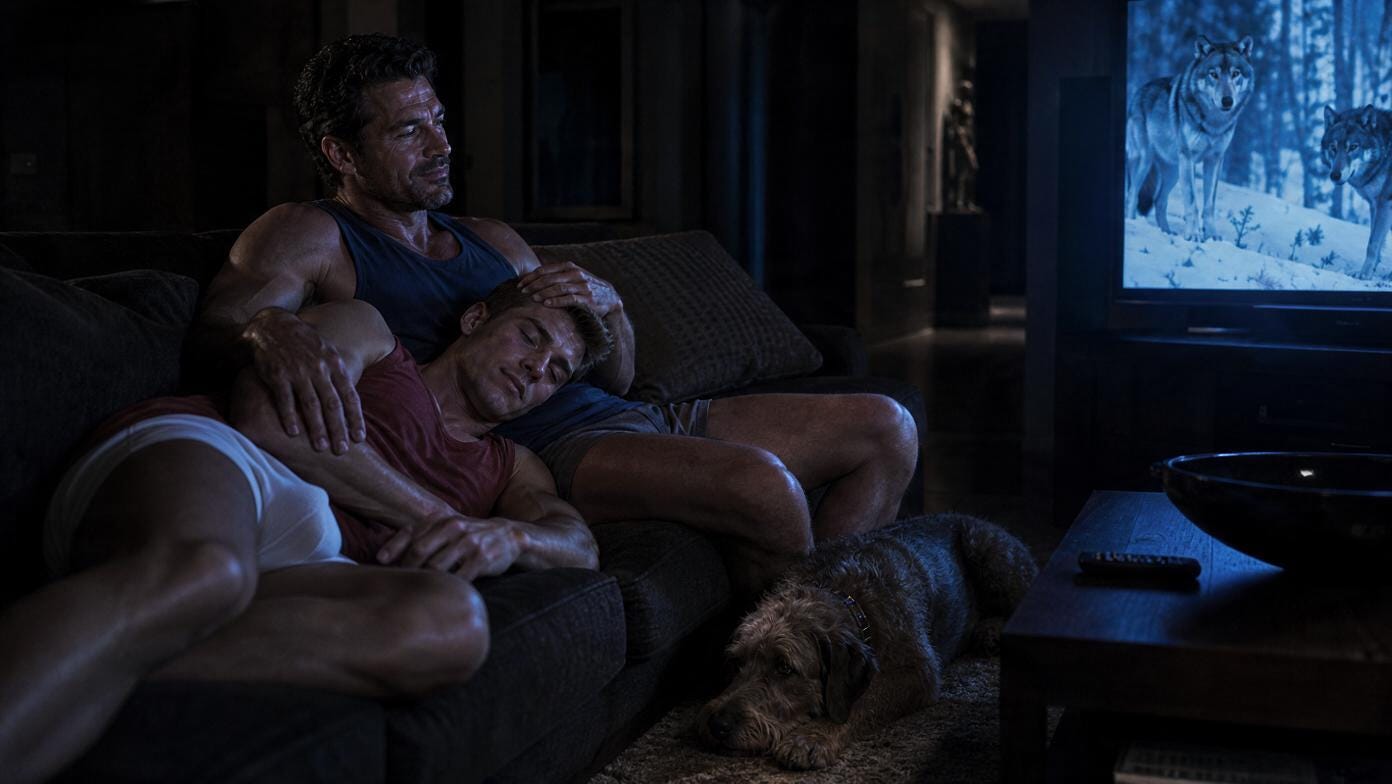
An hour. Maybe longer. Time moved differently in this space without the granularity of minutes, flowing instead in the increments of his hand moving through my hair and the wolves howling on the screen and Mercer’s breathing and the house’s own breathing: the tick of the HVAC, the pool filter cycling on and off, an October evening in North Texas when the cold was finally real enough to press against the windows and make the inside matter.
I didn’t know what I’d been afraid of. That the space between us would feel like absence? That his touch would carry the weight of everything we’d said about James and about bodies and about exactly what had been broken? The fear was there. I could feel it at the edges but it was not the thing filling the room. Something else was in the room instead. It didn’t have a name yet. It was too particular for one. It felt like the moment in a race when you stop counting the lengths and just swim.
Later, in bed with the lamp already off, I turned toward him. My hand found his chest. The steady drumbeat underneath was faster than sleeping, slower than fear. My palm flat against the warm cotton of his t-shirt, the fabric worn soft from a hundred washes, and the rhythm of him under my hand.
“Take this off,” I said, pulling at the fabric.
There was a pause and I was pretty sure his mouth opened but he didn’t say anything. He just pulled the shirt off slowly. I put my head against his side and my hand back on his chest.
His hand came up and covered mine. Not pulling away, not pressing deeper, just holding, the weight of his palm a seal over the contact, an agreement that this—his heartbeat under my hand, the darkness, my face turned toward his in the space where neither of us could see—was a thing we were both choosing to stay inside.
“Yeah,” he said.
We slept like that. Neither of us moved. Somewhere toward the gray hours I surfaced briefly, the touch of his hand still holding mine against his chest, and the room was cold and the bed was warm and the fear was there, at the edges, doing its nightly inventory, but it was farther away than it had been, and the thing in my chest that had been underwater for weeks had surfaced just enough to breathe, and that was all I was going to ask of it tonight.
Til, the sentence that reorganises the entire series is this one:
“Patience was the word I used for waiting and waiting was the word I used for collecting.”
Wade has been the good one. Gentle, unhurried, never forcing. Twelve chapters of that. And you've just revealed that gentle waiting is what James did too — “James was patient, too. He waited. And then he collected.” The only difference is the manner.
That's a genuinely brave thing to do to your own protagonist, because it means every generous moment he's had in this book has to be re-read.
And the account is the answer, and it's the best idea you've had in this series.
Not money to keep him. Money to let him leave. “This is so you never stay anywhere because you can't afford to leave.” And then, to the therapist: “If he can't go, none of this counts.”
Romance almost always writes possession — I'd do anything to keep you. You've written a man who works out that the only ethical thing he can offer is the exit, and hands it over without conditions. Fifteen thousand dollars specifically so that staying becomes a choice rather than a lack of options.
Then there's the island, which I loved before I understood why.
“The island had a counter between two people and nowhere to put your feet up, no cushions to collapse into, no easy way to close the distance. It asked you to stay upright.” Jesse chooses the furniture that makes intimacy impossible, because intimacy is what dissolves his boundaries. Consent architecture, in granite. And then every important scene in the chapter happens there.
And “I know” as the diagnostic. Jesse listens for it “the way you listen for a floorboard you know is going to creak.” Wade doesn't say it — three answers, three specific things, no easy bridge. And then Jesse gives him the only credit he's got: “That's the first time I've believed it.”
Then you run the same phrase through two more rooms. Dr. Levine: “Stop saying that.”Jake: “Don't do that thing. Don't say I know like it settles anything.” Three people in three settings all identifying the same verbal tic as the place where Wade stops doing the work.
Jake's section is the best writing in the chapter. He arrives expecting the usual performance — “the confession that was really a boast, the vulnerability that was really a bid for admiration” — and gets a man telling a story flat, to the table, without once checking the room for its reaction. Jake notices “that” before he notices the content.
And his anger is correct and you let him have it, at length, without softening it. “This is not your story to hand over.” He's right. Wade did that without asking. You don't excuse it.
But then: “You gave me a map. And you did it because you think you're going to fail.” And Jake stays anyway, and pays for both meals, and stands in the parking lot afterward because he doesn't trust his hands on the wheel.
“That's not a compliment. Don't wear it like one. It means if you drop him, you don't get to pretend gravity did it.”
And the new metric, which retires the old one completely: “When he says no and doesn't spend the next twelve hours waiting for me to punish him for it.”
Then the last scene. Jesse crosses the cushion. “Take this off.” Not sex — skin. The first thing he's asked for in the entire book that isn't payment. And Wade says one word.
Yeah.
Extraordinary chapter.
— Arden Tomas 🏳️🌈
Fuuuuuck ok man ill admit it, im team Wade 🙄
I still think Jesse needs professional help though, I really liked the idea of setting up the account for Jesse not many people would see that option or do it.
Jake needs to sort his shit out maybe start with why he stayed with that POS husband of his for so long. Not sure he would be any better for Jesse than Wade, sure he probably wouldn't do what Wade did but I dont think hes ready to give Jesse what he needs either.
Also figure out why hes friends with Wade, he seems very cold towards him most of the time, you can give your friends some hard truths as well as comforting them not sure if the coldness is intentional or just lost in the story, but haven't really seen the friendship between them.
Once again man this chapter dragged me straight back into their world lile im living it with them, hands down the most gripping story i have read recently on here or in a novel, bravo sir.